10 Minutes from Feedback to Production
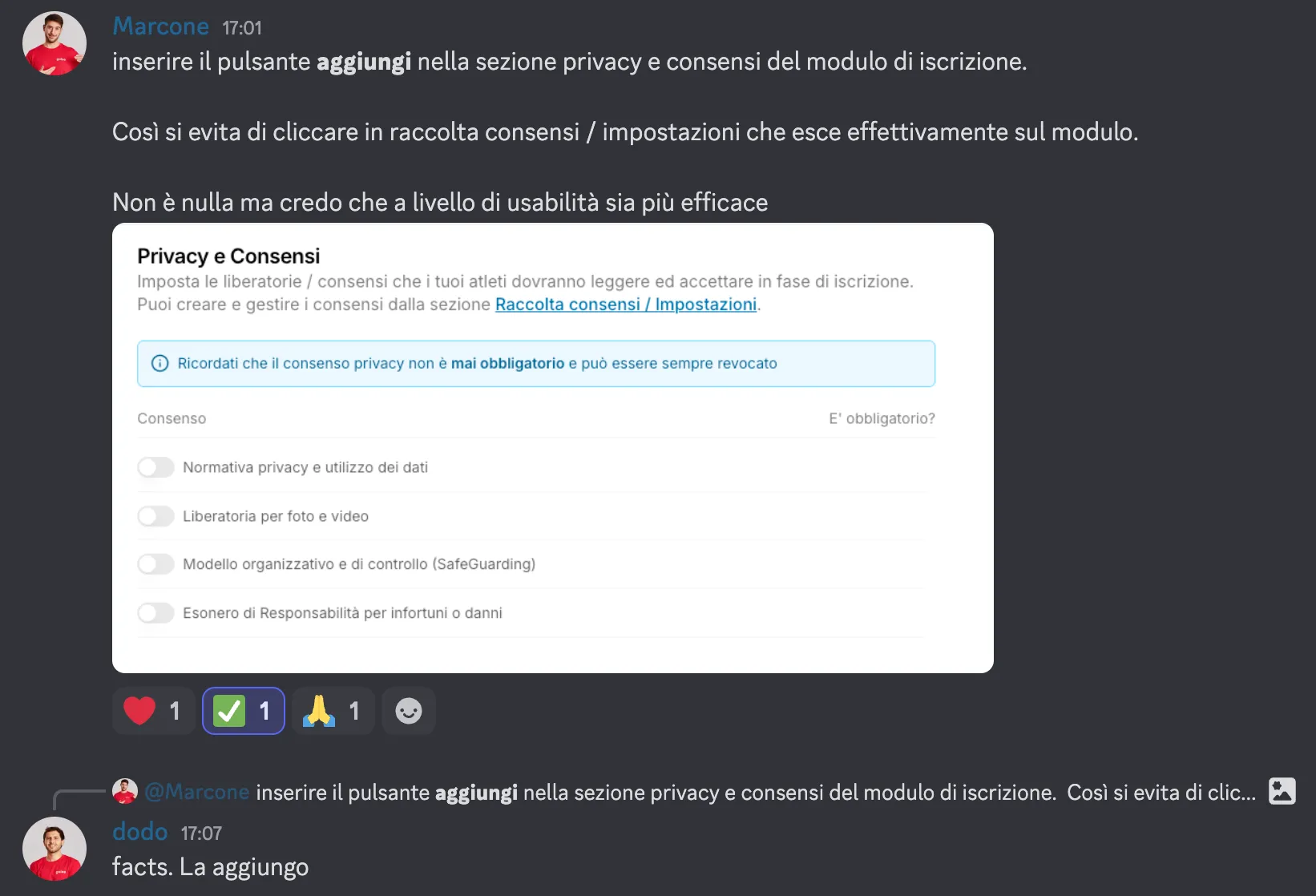
Today at 17:01, Marcone, one of our sales guys, dropped a message in our internal channel #product-feedback on Discord. Nothing fancy, no Jira ticket, no formal request. Just a screenshot and a thought:
“Add a create button in the privacy and consents section of the enrollment form. This way users don’t have to navigate to the consents settings page, which takes them out of the form context. It’s not a big deal, but I think from a usability standpoint it’s way more effective.”
He was right. Our users could link existing consents to forms, but to create a new one, they had to navigate away to a completely different page. Context lost. Flow broken. Awful UX.
I replied: “facts. I’ll add it.”
And then I did something I wouldn’t have done months ago.
The experiment
I took a screenshot of our conversation pasted them directly into Cursor and wrote this prompt:
Let's build this feature. Now, users can link consents to forms
but to create new consents or edit them, they need to navigate
to the consents list page, navigating out the form context.
This is awful. We can have a better UX, allowing users to create
consents directly from the form settings dedicated "Privacy" tab.

Ask me questions and make a plan to build this.
Tip: we may want to extract the "create consent" dialog
(and related mutation) to a re-usable pattern.
Cursor asked me one clarifying question. I answered. It proposed a plan I reviewed the plan, gave the green light, and it just… built it.
The feature worked smoothly. And I pushed it to production.
From Marcone’s Discord message to users having the feature: 10 minutes.
Why this matters (at least for me)
This isn’t a story about AI writing code. That’s the boring part.
This is a story about feedback loops. The distance between “I noticed something could be better” and “it’s live” was reduced to almost nothing. No ticket grooming, no sprint planning, no “we’ll get to it next quarter.” A sales person saw a friction point, communicated it, and it was resolved almost immediately.
Why did this work so smoothly? It’s tempting to give all the credit to AI (and I’m one of the first to do it). But the truth is, it worked because the codebase was (almost) ready. Years of trying to build clean architectures, reusable patterns, composable components: that’s the real enabler.
AI didn’t replace anything. It leveraged what was already there.
The responsibility I’m feeling
We spent years learning this craft. Design patterns, separation of concerns, testing strategies, system design.All of that work finally has a concrete multiplier. It should become infrastructure for non-technical people to safely contribute to the product.
Designers, sales, customer care, marketers… they all see things we don’t. They talk to users every day. They know where the product hurts. And I think every software engineer has a responsibility to shorten that distance.
For me, this is the real democratization of development. Not “everyone learns to code.” But rather: everyone can contribute to the product.
What’s next
My goal, is to enable everyone to tag @cursor directly from the Discord channels and try to build concrete features. And to achieve it, I must spend more and more time on the codebase, on the architecture, on the patterns, on the test coverage, on the CI/CD pipeline.
My role as an engineer is changing quickly, and honestly, I’ve never been more excited about building software.